¿Quién salió con Luis XV de Francia?
Louise-Jeanne Tiercelin de La Colleterie salió con Luis XV de Francia del ? al ?. La diferencia de edad fue de 36 años, 10 meses y 11 días.
Marie Anne de Mailly salió con Luis XV de Francia del ? al ?. La diferencia de edad fue de 7 años, 7 meses y 20 días.
Madame de Pompadour salió con Luis XV de Francia del ? al ?. La diferencia de edad fue de 11 años, 10 meses y 14 días.
Lucie Madeleine d'Estaing salió con Luis XV de Francia del ? al ?. La diferencia de edad fue de 33 años, 2 meses y 25 días.
Françoise de Châlus salió con Luis XV de Francia del ? al ?. La diferencia de edad fue de 24 años, 0 meses y 9 días.
Marie Anne de Coislin salió con Luis XV de Francia del ? al ?. La diferencia de edad fue de 22 años, 7 meses y 2 días.
Irène du Buisson de Longpré salió con Luis XV de Francia del ? al ?.
Marie Thérèse Françoise Boisselet salió con Luis XV de Francia del ? al ?.
Louise Julie de Mailly salió con Luis XV de Francia del ? al ?. La diferencia de edad fue de 0 años, 1 meses y 1 días.
Diane-Adélaïde de Mailly salió con Luis XV de Francia del ? al ?. La diferencia de edad fue de 4 años, 0 meses y 14 días.
Marguerite-Catherine Haynault salió con Luis XV de Francia del ? al ?. La diferencia de edad fue de 26 años, 6 meses y 27 días.
Pauline Félicité de Mailly salió con Luis XV de Francia del ? al ?.
Catherine Éléonore Bénard salió con Luis XV de Francia del ? al ?.
Marie-Louise O'Murphy salió con Luis XV de Francia del al . La diferencia de edad fue de 27 años, 8 meses y 6 días.
Anne Couppier de Romans salió con Luis XV de Francia del al . La diferencia de edad fue de 27 años, 3 meses y 17 días.
Madame du Barry salió con Luis XV de Francia del al . La diferencia de edad fue de 33 años, 6 meses y 4 días.
Luis XV de Francia

Luis XV de Francia (en francés: Louis XV; Palacio de Versalles, 15 de febrero de 1710-10 de mayo de 1774), llamado el Bien Amado, fue rey de Francia y de Navarra entre los años 1715 y 1774. También ostentó los títulos de copríncipe de Andorra y duque de Anjou. Heredado el trono de su bisabuelo Luis XIV a la edad de cinco años, habiendo fallecido anteriormente su padre y su abuelo, pasó sus primeros años de reinado en relativa tranquilidad, rodeado de preceptores que le proveyeron una gran cultura, mientras que el poder efectivo fue entregado a varios regentes. Al alcanzar la mayoría de edad le confió el gobierno al cardenal Fleury, su antiguo preceptor. Su indiferencia política y las derrotas militares, hicieron que la popularidad del monarca descendiese bruscamente, por lo que es recordado principalmente por su contribución a la cultura y a las artes, impulsadas por su amante madame de Pompadour quien dio nombre al estilo artístico que dominó el país durante su reinado.
Su reinado de cerca de 59 años fue el segundo más largo en la historia francesa, solo superado por el de su predecesor y bisabuelo el rey Luis XIV que había gobernado durante 72 años. A diferencia de Luis XIV no tuvo contacto directo con la vida política de su país: se reunía con poca frecuencia con sus ministros y actuó en contra de sus expectativas, tramando una red de diplomáticos y espías. Su desinterés por la política y la constante sucesión de ministros que debilitaban el poder de Francia en Europa contribuyeron a sentar las bases para la Revolución francesa. Al inicio de su reinado fue amado por el pueblo, que rápidamente le apodó como el Bien Amado. Con los años, su debilidad en la toma de decisiones y la constante e intrigante presencia de sus amantes dinamitó su popularidad, produciéndose algunas celebraciones a su muerte en París. Por ello, hubo de celebrarse en secreto su funeral, para evitar que se produjeran burlas públicas ante su ataúd, como ocurrió con su predecesor.
En 1748 Luis XV, ganada la batalla de Fontenoy de 1745 devolvió los Países Bajos Austríacos. Cedió Nueva Francia en América del Norte a Gran Bretaña y España al final de la desastrosa Guerra de los Siete Años en 1763. Incorporó a Francia los territorios del Ducado de Lorena y la República de Córcega, siendo estas sus mayores ganancias territoriales durante su reinado. Los historiadores generalmente critican su reinado, citando cómo los informes de su corrupción avergonzaron a la monarquía, mientras que sus guerras agotaron la hacienda real y produjeron pocas ganancias. Su nieto y sucesor Luis XVI heredaría un reino que necesitaba una reforma financiera y política que finalmente conduciría a la Revolución Francesa de 1789.
Leer más...Louise-Jeanne Tiercelin de La Colleterie
Louise-Jeanne Tiercelin de La Colleterie (26 December 1746 – 5 July 1779), known as Madame de Bonneval, was a mistress to King Louis XV of France from 1762 to 1765. She was the king's Petite maîtresse (unofficial mistress), not his Maîtresse-en-titre (official mistress).
Leer más...Luis XV de Francia
Marie Anne de Mailly

Marie-Anne de Mailly-Nesle, marquise de La Tournelle, duchesse de Châteauroux, née le à Paris, paroisse Saint-Sulpice, où elle est morte, le , est une favorite de Louis XV.
Leer más...Luis XV de Francia
Madame de Pompadour

Jeanne Antoinette Poisson, Marquise de Pompadour (, French: [pɔ̃paduʁ] ; 29 December 1721 – 15 April 1764), commonly known as Madame de Pompadour, was a member of the French court. She was the official chief mistress of King Louis XV from 1745 to 1751, and remained influential as court favourite until her death.
Pompadour took charge of the king's schedule and was a valued aide and advisor, despite her frail health and many political enemies. She secured titles of nobility for herself and her relatives, and built a network of clients and supporters. She was particularly careful not to alienate the popular Queen, Marie Leszczyńska. On 8 February 1756, the Marquise de Pompadour was named as the thirteenth lady-in-waiting to the queen, a position considered the most prestigious at the court, which accorded her with honors.
Pompadour was a major patron of architecture and decorative arts, especially porcelain. She was a patron of the philosophes of the Enlightenment, including Voltaire.
Hostile critics at the time generally tarred her as a malevolent political influence, but historians are more favorable, emphasizing her successes as a patron of the arts and a champion of French pride. Modern historians suggest that the critics of Pompadour were driven by fears over the overturning of the existing hierarchies that Pompadour's power and influence represented, as a woman who was not born into the aristocracy.
Leer más...Luis XV de Francia
Lucie Madeleine d'Estaing
Lucie Madeleine d'Estaing, dame de Ravel, est née le à Paris et morte le à Clermont-Ferrand.
Leer más...Luis XV de Francia
Françoise de Châlus

Françoise de Chalus, duquesa de Narbonne-Lara, señora de La Bove (24 de febrero de 1734, Chalus-7 de julio de 1821, París) fue amante del rey Luis XV de Francia.
Leer más...Luis XV de Francia
Marie Anne de Coislin
Marie Anne de Coislin (1732-1817), was a French aristocrat, known as the mistress to Louis XV of France in 1755. She was the king's Petite maîtresse (unofficial mistress), not his Maîtresse-en-titre (official mistress).
She was the daughter of the marquis Louis de Mailly (1696-1767) and the lady-in-waiting Anne Françoise Elisabeth Arbaleste de Melun and married in 1750 to the duke Charles Georges René du Cambout de Coislin (d. 1771), but they separated early on and she moved back with her parents.
In 1755, Louis François, Prince of Conti launched her as his candidate to replace Madame de Pompadour as official mistress of the king. She was the first serious candidate to be put up against Madame de Pompadour since Charlotte Rosalie de Choiseul-Beaupré, and she was also to be the last. She did succeed to be the secret lover of the king, which attracted some attention at court. She became known as l'altière Vasthi. Ultimately, however, the plot failed, and she was ousted from court by Madame de Pompadour. After this, there was no more serious rival to replace Madame de Pompadour, and the king mainly settled with his unofficial lovers at the Parc-aux-Cerfs.
Marie Anne de Coislin had affairs with the Prince de Conti and the count de Coigny, and was claimed to have had affairs with Christian VI of Denmark, Gustav III of Sweden and Peter III of Russia. It is unknown if these rumours where true, but Christian VI and Gustav III did visit her during their visits to Paris, which attracted attention at the time.
She did not leave France during the French Revolution, but lived as a servant in Rouen, Brittany and Vendée during the Reign of Terror. After the fall of Robespierre, she resumed her former life and property. She remarried in 1793 to Louis-Marie duc de Mailly (d. 1795).
Leer más...Luis XV de Francia
Irène du Buisson de Longpré
Irène du Buisson de Longpré (c. 1720–1767), was a French noblewoman, mistress to Louis XV of France. She was the king's Petite maîtresse (unofficial mistress), not his Maîtresse-en-titre (official mistress).
Leer más...Luis XV de Francia
Marie Thérèse Françoise Boisselet
Marie Thérèse Françoise Boisselet (1731 – 1800) was a petite maîtresse of King Louis XV of France.
Boisselet was born to Pierre Sulpice Boisselet and Marie Thérèse Carouailles. Her father was an employee of the king's kitchen staff, with the title 'Contrôleur de la Bouche du Roi et chef du gobelet de Mme la Dauphine'. Marie Thérèse Françoise Boisselet was described as a beauty, and she agreed to become the lover of the king. The affair was not an official one; she was recruited to be a petite maîtresse (unofficial mistress) of the king in Parc-aux-Cerfs. She had one child with the king, Charles Louis Cadet de Gassicourt (1769–1821).
In 1771, she married the chemist Louis Claude Cadet de Gassicourt, who adopted her son. According to Paul Thiébault, Louis XV benefitted the career of Cadet de Gassicourt in the Royal Academy because of his marriage to his former lover.
Leer más...Luis XV de Francia
Louise Julie de Mailly

Louise Julie de Mailly Nesle, condesa de Mailly (1710-París, 1751) fue la mayor de las cinco hermanas de Nesle, cuatro de las cuales fueron amantes del rey Luis XV, en su caso lo fue de 1732 a 1742.
Leer más...Luis XV de Francia
Diane-Adélaïde de Mailly

Diane Adélaïde de Mailly, duquesa de Lauraguais (11 de febrero de 1713-París, 20 de febrero de 1769), fue la tercera de las cinco hermanas Nesle, cuatro de las cuales se convertirían en amantes del Luis XV de Francia.
Leer más...Luis XV de Francia
Marguerite-Catherine Haynault
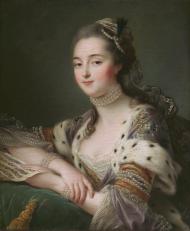
Marguerite-Catherine Haynault (1736–1823) was a French noblewoman, mistress to Louis XV from 1759 to 1762. She was the king's Petite maîtresse (unofficial mistress), not his Maîtresse-en-titre (official mistress).
She was born in Paris as the daughter of the tobacco merchant Jean-Baptiste Haynault and Catherine Coupris de La Salle. In 1759, she was recruited to be a petite maîtresse (unofficial mistress) of the king in Parc-aux-Cerfs by Dominique Guillaume Lebel.
She served as the king's lover with Lucie-Madeleine d'Estaing, who lived in the Parc-aux-Cerfs at the same time and alternated with her, one replacing the other in the king's bed during their pregnancies; Louise-Jeanne Tiercelin de La Colleterie was also housed there, while Anne Couppier de Romans had refused and was given her own house. She had two daughters with the king: Agnès-Louise de Montreuil (born 1760) and Anne-Louise de La Réale (born 1762), who were officially registered with two officers as fathers. Her daughters were both taken from her, raised in the convent school Chaillot, and given noble status, dowries and arranged marriages with noblemen as adults.
The king discontinued their relationship in 1762, and she was awarded a pension. In 1766, she married Blaise Arod, Marquis de Montmelas-Saint-Sorlin (d. 1815).
She left France during the French Revolution and lived abroad during the Reign of Terror. After the fall of Maximilien Robespierre, she returned to France, applied to be removed from the list of emigres and reclaimed her property.
Leer más...Luis XV de Francia
Pauline Félicité de Mailly

Pauline Félicité de Mailly-Nesle, née à Paris en 1712 et morte le , par son mariage comtesse de Vintimille (1739), est une favorite de Louis XV.
Leer más...Luis XV de Francia
Catherine Éléonore Bénard
Marie Catherine Éléonore Bénard (Catherine Éléonore Bernard; 1740 – 23 February 1769) was a French lady-in-waiting and alleged petite maîtresse to King Louis XV of France in 1768-69.
Leer más...Luis XV de Francia
Marie-Louise O'Murphy

Marie-Louise O'Murphy de Boisfaily, även kallad Mademoiselle de Morphy eller la belle Morphise, född 21 oktober 1737 i Rouen, död 11 december 1814 i Paris, var älskarinna till Ludvig XV av Frankrike. Hon hade denna roll 1753–1755, varefter hon ersattes i denna roll av sin syster Brigitte.
Leer más...Luis XV de Francia
Anne Couppier de Romans

Anne Couppier de Romans (19 de junio de 1737-27 de diciembre de 1808), baronesa de Meilly-Coulonge y marquesa de Cavanac, fue amante del rey Luis XV de Francia desde 1760 hasta 1765.
Leer más...Luis XV de Francia
Madame du Barry

Madame du Barry, geboren als Marie-Jeanne Bécu (Vaucouleurs, 19 augustus 1743 – Parijs, 8 december 1793), was een beroemde maîtresse van Lodewijk XV van Frankrijk. Zij was van bescheiden afkomst, maar haar relaties met rijke mannen vergrootten haar sociale status aanzienlijk.
Leer más...