¿Quién salió con Ptolomeo II?
Stratonice salió con Ptolomeo II del ? al ?.
Mnesis salió con Ptolomeo II del ? al ?.
Estratónice de Libia salió con Ptolomeo II del ? al ?.
Bilistiche salió con Ptolomeo II del ? al ?.
Kleino salió con Ptolomeo II del ? al ?.
Ptolomeo II
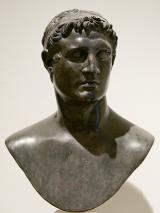
Ptolomeo II Filadelfo, «el que ama a su hermana» (en griego antiguo: Πτολεμαῖος Φιλάδελφος) (308-246 a. C.), fue el segundo faraón de la dinastía ptolemaica; gobernó en Egipto de 285 a 246 a. C.
Leer más...Stratonice
Ptolomeo II
Mnesis
Mnesis (fl. 3rd century BCE) was a mistress of Ptolemy Philadelphus. According to Athenaeus, she was a flute-player.
Leer más...Ptolomeo II
Estratónice de Libia
Stratonice (Greek: Στρατονίκη; fl. possibly late second half of 4th century BC and first half of 3rd century BC) was a Greek noblewoman of very high status and was the wife of the Ptolemaic official Archagathus of Libya.
Stratonice is an unattested person and is only known through surviving evidence. When her husband was an Epistates in Libya serving in Cyrenaica, Stratonice and her husband Archagathus on marble piece made a dedication of a temenos to Isis and Serapis at Alexandria on behalf of Archagathus’ maternal uncle, the Ptolemaic prince Ptolemy II Philadelphus and his maternal grandmother the first Ptolemaic Queen Berenice I of Egypt. The record is dated from ca. 283 BC-278 BC and is on display in the Greco-Roman Museum of Alexandria. The inscription below translated in Greek and English reads:
- ὑπὲρ βασιλέως Πτολεμαίου
- τοῦ Πτολεμαίου καὶ Βερενίκης
- Σωτήρων Άρχάγαθος Άγαθοκλέους
- ὁ ἐπιστάτης τῆς Λιβύης
- καὶ ἡ γυνὴ Στρατονίκη
- Σαράπιδι Ἴσιδι τὸ τέμενος.
- King Ptolemy
- son of Ptolemy and Berenice
- the Saviours Archagathus son of Agathocles
- epistates of Libya
- and his wife Stratonice
- Serapis, Isis of temenos.
Stratonice made a dedication, to Ptolemy II's sister the Ptolemaic princess Arsinoe II. The original statue she dedicated was a Hellenistic original statue of Arsinoe II which must be dated from 280 BC-278 BC. The original Hellenistic statue of Arsinoe II was later copied as a Roman statue. The text from the Roman copy below translated in Greek and English reads:
- Βασίλισσαν Ὰρσινόην βασιλέως
- Πτολεμαίου καί βασιλίσσης Βερενίκης
- Στρατονίκη βασιλέως Δημητρίου
- Queen Arsinoe daughter of King
- Ptolemy and Queen Berenice
- Stratonice daughter of King Demetrius
The inscription reveals she was a daughter of a King Demetrius and there is a possibility that she could identified as an otherwise-unknown daughter of Greek Macedonian King Demetrius I Poliorcetes. According to the suggestions of L. Morretti (RFIC 93, 1965, 73) and R.S. Bagnall (Philologus 120, 1976, 195) that Stratonice may have been the sister of Alexander, son of Demetrius I Poliorcetes and Deidamia. Alexander lived his remaining life as an honorary hostage in Egypt and Stratonice may have accompanied him to Egypt. Alexander and Stratonice may have accompanied their maternal uncle Pyrrhus of Epirus to Egypt in c.299 BC when Pyrrhus lived as a hostage in the country. Stratonice is not to be confused with Stratonice of Syria, the known daughter of Demetrius I Poliorcetes of this name, who married as the second wife of Seleucus I Nicator and the wife of Antiochus I Soter. If this suggestion is correct, Stratonice was born at the same time as her husband between 301 BC-298 BC. There is no record of any children born to her marriage to Archagathus.
Stratonice may have been the same Stratonice who had a celebrated Mausoleum at Eleusis near Alexandria and was a later mistress of Ptolemy II.
Leer más...Ptolomeo II
Bilistiche
Bilistiche, ou Bellistiche ou Belistiche (en grec ancien : Βιλιστίχη), est une hétaïre du IIIe siècle avant notre ère qui devient la compagne du pharaon Ptolémée II et qui est déifiée après sa mort.
Son origine est incertaine : Macédoineselon Pausanias, ou Argolide selon Athénée de Naucratis qui rapporte sa prétention à descendre des Atrides. Mais Plutarque rapporte qu'elle fut vendue au marché comme esclave.
Elle est l'une des premières femmes après Cynisca à gagner un prix olympique dans une course hippique en remportant la synoris (course de chars attelés) menée par deux poulains lors des 128e Jeux olympiques antiques, en -268. Elle récidive aux Jeux suivants (-264) en remportant la course de char à quatre poulains.
Elle devient la compagne de Ptolémée II vers -268. Elle est sans doute la mère de Ptolémée Andromaque, fils illégitime de Ptolémée II.
Elle est choisie comme canéphore en -251. Son nom apparaît en effet comme celui d'une prêtresse de trente-cinq ans, fille d'un certain Philon et proche du pharaon Ptolémée II dans un papyrus égyptien enregistrant son serment. Certains hellénistes modernes, doutant qu'un tel honneur ait été accordé à une ancienne prostituée, ont proposé de voir en elle une homonyme de la célèbre propriétaire du char vainqueur.
D'après Clément d'Alexandrie, elle meurt à Canope à une date inconnue, mais avant -246. Ptolémée fait transporter et ensevelir son corps au temple de Sérapis dans le quartier de Rakôtis. Le pharaon la déifie ensuite sous le nom d'Aphrodite Bilistiche.
Leer más...Ptolomeo II
Kleino
Kleino (3rd-century BC) was an Ancient Greek musician and courtier.
She was a professional flute player, active in the Greek city of Alexandria in Egypt. She was appointed to the prestigious office of vine bearer to the king, Ptolemy II of Egypt. She became a well known public figure. Polybius reported that several public statues of her were seen all over Alexandria.
Leer más...