¿Quién salió con Olga Zherebtsova?
Jorge IV del Reino Unido salió con Olga Zherebtsova del ? al ?.
Olga Zherebtsova
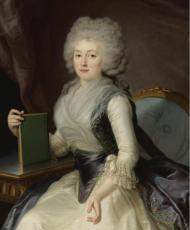
Olga Alexandrovna Zherebtsova (née Zubova; Russian: Ольга Александровна Жеребцова; 1766–1849), also known as Madame Gerebtzoff, was a Russian aristocrat and socialite, known foremost for her political involvement and love life. She was the sister of the celebrated Zubov brothers, Prince Platon and Counts Nikolay and Valerian.
After her brothers' fall from grace following Catherine II's death, they conspired with Count Pahlen to assassinate her successor Paul whom they viewed as the author of their misfortunes. The conspirators met and discussed their plans at Zherebtsova's house. Some maintain that she appropriated the funds the British government passed through her lover Charles Whitworth, 1st Earl Whitworth to the conspirators. "Once diplomatic relations with England were broken, Whitworth was ordered to leave the capital with all his staff".
Zherebtsova followed Lord Whitworth to England where she was shocked to learn about his prospective betrothal to the widow of John Sackville, 3rd Duke of Dorset. It was rumored that Madame Gerebtzoff extorted from her rival some 10,000 pounds before turning her attention to the Prince Regent, whose mistress she is said to have become. She is even said to have given birth to a natural son, named George Nord, after his purported royal father.
In the declining years of her life, Madame Gerebtzoff returned to the Russian capital, where she again became immersed in court intrigues through her powerful son-in-law, Prince Aleksey Orlov. In the 1840s, she was the patron of Alexander Herzen, who would recall her character and opinions with admiration in his memoirs "My Past and Thoughts":
Leer más...Like a tree in winter, she maintained the linear outline of her boughs after the leaves had fallen off and the scraggy bare branches had been pinched with cold, all the more clearly demonstrating her magnificent stature, her daring bulk, and the trunk, though white with frost, still stalking lordly and sulkily and braving every tempest and gust.
Jorge IV del Reino Unido
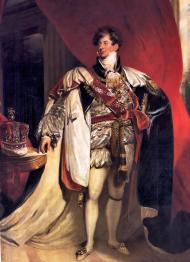
Jorge IV del Reino Unido (George Augustus Frederick; nacido en el Palacio de St. James, Londres, 12 de agosto de 1762 y fallecido en el Castillo de Windsor, Berkshire, 26 de junio de 1830) fue rey del Reino Unido y de Hannover, desde su ascenso al trono el 29 de enero de 1820 hasta su muerte en 1830.
Anteriormente había servido como príncipe regente cuando su padre, Jorge III, sufrió una permanente recaída de locura a causa de la porfiria que padecía. La regencia de Jorge —que duró nueve años, desde 1811 hasta la muerte de su padre en 1820— estuvo marcada por la victoria en las Guerras Napoleónicas en Europa. Jorge IV fue un monarca que interfirió en numerosas ocasiones en la política (especialmente en el asunto de la emancipación católica), aunque no estuvo tan presente en su reinado como lo fue el de su padre, destacando más en su labor como regente antes de llegar a ser rey. Durante la mayor parte de su regencia y reinado, lord Liverpool controló el gobierno como primer ministro. Jorge IV también es recordado como un príncipe y monarca extravagante, por lo que fue apodado el «Rey Dandi», el «Primer Caballero de Inglaterra» y, despectivamente debido a su obesidad, el «Príncipe de las Ballenas».[cita requerida]
Se dice que cada vez que Jorge IV conquistaba una mujer, cortaba un mechón de su cabello y lo colocaba en un sobre con el nombre de la dama, como "trofeo". En el momento de su muerte se asegura que tenía en su poder siete mil de estos sobres con cabellos. Tuvo una pésima relación con su padre y con su mujer, Carolina de Brunswick-Wolfenbüttel, a la que llegó a excluir de su coronación. Fue, sin embargo, un patrono de las artes; durante su regencia y su reinado destacaron figuras literarias como lord Byron, Walter Scott y Jane Austen. Jorge IV fue responsable de la construcción del Royal Pavilion en Brighton.
Leer más...