¿Quién salió con Isabella Ingram-Seymour-Conway, Marchioness of Hertford?
George IV of the United Kingdom salió con Isabella Ingram-Seymour-Conway, Marchioness of Hertford del ? al ?. La diferencia de edad fue de 3 años, 1 meses y 5 días.
Isabella Ingram-Seymour-Conway, Marchioness of Hertford

Isabella Anne Seymour-Conway, Marchioness of Hertford (7 July 1759 – 12 April 1834) was an English landowner and courtier and a mistress of King George IV when he was Prince of Wales. She was born at Temple Newsam in Leeds, and was the eldest daughter of Charles Ingram, 9th Viscount of Irvine, and his wife Frances Gibson Shepheard Ingram. She married Francis Ingram-Seymour-Conway, 2nd Marquess of Hertford, in 1776, at age sixteen, being his second wife. She was known as Lady Beauchamp until 1794 when her husband succeeded his father.
Isabella was co-heiress to Temple Newsam along with her four sisters, and owned properties in Worcestershire, Norfolk, Ireland and London.
Tall, handsome, and elegant, she caught the attention of the Prince of Wales most likely at a ball or concert at Manchester House, the London home of the Hertfords. George was also friends with Isabella's son, Lord Yarmouth, born in 1777. In 1806, the Hertfords became guardians to Mary 'Minney' Seymour, a favourite of the Prince. Charles was made Master of the Horse in 1804 and a Knight of the Garter in 1807.
At first, Isabella rejected George's advances, causing him to become depressed. He made a visit to Isabella's mother at Temple Newsam in 1806 whilst attending Doncaster races as an excuse to see Isabella. George became obsessed with Isabella and became ill when parted from her so that the Hertfords travelled to London to see him and George was miraculously cured. In 1807, Isabella, now almost fifty, began a relationship with George who was then in his mid-forties. As a result, the Prince was a regular guest at Hertford House, Hertford's London residence, and Ragley Hall in Warwickshire. A Tory herself, she was influential in turning the Prince toward the Tories and away from the Whigs, and used her London residence as the headquarters for Tory sympathisers. Isabella was criticised by the House of Lords and in the press for her influence on George; satirical prints by George Cruikshank and others were produced.
The Marchioness's predecessor as the Prince Regent's mistress had been Maria Fitzherbert, a Roman Catholic. Other Catholics disapproved of the Marchioness's influence over the prince, referring to "the fatal witchery of an unworthy secret influence" that they felt had turned him against the idea of Catholic emancipation. George Canning, speaking for the party in power, made use of these comments to say that, if Lady Hertford was really responsible for the prince's political decisions, she was "Britain's guardian angel". Isabella made a point of humiliating Mrs Fitzherbert and by 1811 the Prince had formally separated from her.
On the death of her mother in 1807, she inherited Temple Newsam in West Yorkshire, where the Prince of Wales had paid her a visit. She and her husband added the name of Ingram to their surname due to the fortune they inherited from her family. Lavish entertainments were held at Hertford House attended by the Prince, members of the royal family and visiting nobles, including for victory celebrations in 1814. Isabella's dresses were reported in the press including a Greek-style ostrich feather head-dress worn in 1813 styled on the Prince's crest.
Lady Hertford's relationship with the Prince, now prince regent, ended in 1819, when he turned his attentions to Elizabeth Conyngham, Marchioness Conyngham. According to Greville’s diary for 9 June 1820:
Somebody asked Lady Hertford if she had been aware of the King's admiration for Lady Conyngham, and whether he had ever talked to her about Lady C. She replied that 'intimately as she had known the King, and openly as he had always talked to her upon every subject, he had never ventured to speak to her upon that of his mistresses'.
Isabella continued to spend the season in London, but otherwise lived at Temple Newsam. Here she busied herself with charitable works, being the patron or member of many events and societies, and was noted for her benevolence to the poor as well as her generosity to the servants at Temple Newsam who held an annual ball and supper in the house. Lady Hertford died in 1834 after catching a cold on her way from Temple Newsam to London by carriage. Her obituary in The Leeds Intelligencer described her as 'Her intellectual character, and high attainments, formed the least part of her excellencies; however enlightened her mind, her heart was warmer still. To the poor and the distressed her munificence was all but unbounded'.
Leer más...George IV of the United Kingdom
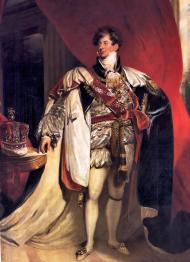
Jorge IV del Reino Unido (George Augustus Frederick; nacido en el Palacio de St. James, Londres, 12 de agosto de 1762 y fallecido en el Castillo de Windsor, Berkshire, 26 de junio de 1830) fue rey del Reino Unido y de Hannover, desde su ascenso al trono el 29 de enero de 1820 hasta su muerte en 1830.
Anteriormente había servido como príncipe regente cuando su padre, Jorge III, sufrió una permanente recaída de locura a causa de la porfiria que padecía. La regencia de Jorge —que duró nueve años, desde 1811 hasta la muerte de su padre en 1820— estuvo marcada por la victoria en las Guerras Napoleónicas en Europa. Jorge IV fue un monarca que interfirió en numerosas ocasiones en la política (especialmente en el asunto de la emancipación católica), aunque no estuvo tan presente en su reinado como lo fue el de su padre, destacando más en su labor como regente antes de llegar a ser rey. Durante la mayor parte de su regencia y reinado, lord Liverpool controló el gobierno como primer ministro. Jorge IV también es recordado como un príncipe y monarca extravagante, por lo que fue apodado el «Rey Dandi», el «Primer Caballero de Inglaterra» y, despectivamente debido a su obesidad, el «Príncipe de las Ballenas».[cita requerida]
Se dice que cada vez que Jorge IV conquistaba una mujer, cortaba un mechón de su cabello y lo colocaba en un sobre con el nombre de la dama, como "trofeo". En el momento de su muerte se asegura que tenía en su poder siete mil de estos sobres con cabellos. Tuvo una pésima relación con su padre y con su mujer, Carolina de Brunswick-Wolfenbüttel, a la que llegó a excluir de su coronación. Fue, sin embargo, un patrono de las artes; durante su regencia y su reinado destacaron figuras literarias como lord Byron, Walter Scott y Jane Austen. Jorge IV fue responsable de la construcción del Royal Pavilion en Brighton.
Leer más...