¿Quién salió con Barbara Villiers?
John Churchill, 1st Duke of Marlborough salió con Barbara Villiers del ? al ?. La diferencia de edad fue de 9 años, 6 meses y 9 días.
Carlos II de Inglaterra y Escocia salió con Barbara Villiers del al . La diferencia de edad fue de 10 años, 5 meses y 19 días.
Barbara Villiers

Barbara Villiers (*noviembre de 1641-†9 de octubre de 1709), primera duquesa de Cleveland y amante del rey Carlos II de Inglaterra, más conocida por su título de condesa de Castlemaine.
Leer más...John Churchill, 1st Duke of Marlborough
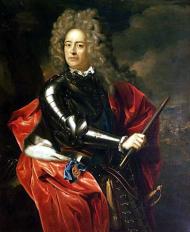
General John Churchill, 1st Duke of Marlborough, 1st Prince of Mindelheim, 1st Count of Nellenburg, Prince of the Holy Roman Empire, (26 May 1650 – 16 June 1722 O.S.) was a British army officer and statesman. From a gentry family, he served as a page at the court of the House of Stuart under James, Duke of York, through the 1670s and early 1680s, earning military and political advancement through his courage and diplomatic skill. He is known for never having lost a battle.
Churchill's role in defeating the Monmouth Rebellion in 1685 helped secure James on the throne, but he was a key player in the military conspiracy that led to James being deposed during the Glorious Revolution. Rewarded by William III with the title Earl of Marlborough, persistent charges of Jacobitism led to his fall from office and temporary imprisonment in the Tower of London. William recognised his abilities by appointing him as his deputy in Southern Netherlands (modern-day Belgium) before the outbreak of the War of the Spanish Succession in 1701, but not until the accession of Queen Anne in 1702 did he secure his fame and fortune.
Marriage to Sarah Jennings and her relationship with Anne ensured Marlborough's rise, first to the captain-generalcy of British forces, then to a dukedom. As de facto leader of Allied forces in the Low Countries, his victories at battles of Blenheim (1704), of Ramillies (1706), of Oudenarde (1708), and of Malplaquet (1709) ensured his place in history as one of Europe's great generals. His wife's stormy relationship with the Queen, and her subsequent dismissal from court, was central to his own fall. Incurring Anne's disfavour, and caught between Tory and Whig factions, Marlborough was forced from office and went into self-imposed exile. He returned to favour with the accession of George I to the throne in 1714, but a stroke in 1716 ended his career.
Marlborough's leadership of the main Allied army against Louis XIV from 1701 to 1711 helped to consolidate Britain's emergence as a front-rank power, while his ability to maintain unity in the fractious coalition demonstrated his diplomatic skills. He is often remembered by military historians as much for his organisational and logistic skills as his tactical abilities. Marlborough's military exploits have resulted in successive historians describing him as one of the finest military commanders in history.
Leer más...Barbara Villiers
Carlos II de Inglaterra y Escocia
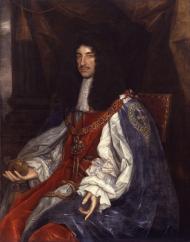
Carlos II (Palacio de St. James, Londres, 29 de mayo de 1630-Palacio de Whitehall, Londres, 6 de febrero de 1685) fue rey de Inglaterra, Escocia e Irlanda desde el 29 de mayo de 1660 hasta su muerte, en 1685.
Su padre, Carlos I, fue ejecutado en 1649 tras la guerra civil inglesa; la monarquía fue entonces abolida y el país se convirtió en una república bajo la tiranía de Oliver Cromwell, el «Lord Protector». En 1660, dos años después de la muerte de Cromwell, se restauró la monarquía bajo Carlos II.
A diferencia de su padre, Carlos II fue hábil en su relación con el Parlamento. Fue durante su reinado cuando se desarrollaron los partidos Whig (liberal) y Tory (conservador). Se hizo célebre por sus numerosos hijos ilegítimos, de los que reconoció a catorce. Conocido como «el Alegre Monarca», Carlos II favoreció las artes y las ciencias y, antipuritano, fue menos restrictivo que sus predecesores al mandar abrir de nuevo los teatros en 1660, cerrados desde 1642. Al abrazar el catolicismo en su lecho de muerte, Carlos II se convirtió en el primer católico que reinaba en Inglaterra desde la muerte de María I en 1558, y en Escocia desde la deposición de su bisabuela María, Reina de los Escoceses, en 1567.
En su honor, el astrónomo Edmund Halley nombró a la estrella alfa de los Lebreles como Cor Caroli, corazón de Carlos.
Leer más...