¿Quién salió con Mary Robinson (poet)?
George Capel-Coningsby, 5th Earl of Essex salió con Mary Robinson (poet) del ? al ?. La diferencia de edad fue de 1 años, 0 meses y 14 días.
Banastre Tarleton salió con Mary Robinson (poet) del ? al ?. La diferencia de edad fue de 4 años, 3 meses y 6 días.
Charles James Fox salió con Mary Robinson (poet) del ? al ?. La diferencia de edad fue de 9 años, 10 meses y 3 días.
George IV of the United Kingdom salió con Mary Robinson (poet) del ? al ?. La diferencia de edad fue de 3 años, 8 meses y 16 días.
Mary Robinson (poet)
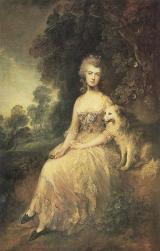
Mary Robinson (née Darby; 27 November 1757 – 26 December 1800) was an English actress, poet, dramatist, novelist and celebrity figure. She lived in England, in the cities of Bristol and London; she also lived in France and Germany for a time. She enjoyed poetry from the age of seven and started working, first as a teacher and then as an actress, from the age of 14. She wrote many plays, poems and novels. She was a celebrity, gossiped about in newspapers, famous for her acting and writing. During her lifetime she was known as "the English Sappho". She earned her nickname "Perdita" for her role as Perdita (heroine of Shakespeare's The Winter's Tale) in 1779, and was the first public mistress of King George IV while he was still Prince of Wales.
Leer más...George Capel-Coningsby, 5th Earl of Essex

George Capel-Coningsby, 5th Earl of Essex FSA (13 November 1757 – 23 April 1839) was an English aristocrat and politician, and styled Viscount Malden until 1799. His surname was Capell until 1781.
Leer más...Mary Robinson (poet)
Banastre Tarleton

Banastre Tarleton (21 de agosto de 1754-16 de enero de 1833) fue un oficial del Ejército Británico y político inglés, con una destacada participación en la Guerra de Independencia de los Estados Unidos. Al finalizar el conflicto, Tarleton fue elegido parlamentario por Liverpool y se convirtió en un prominente político whig.
Durante la guerra, se convirtió en el punto central de una campaña de propaganda que sostenía que había disparado a tropas del Ejército Continental que se habían rendido en la Batalla de Waxhaws. En una publicación de Robert D. Bass titulada The Green Dragoon: The Lives of Banastre Tarleton and Mary Robinson (1952) se le dio el sobrenombre de Bloody Ban y el Carnicero, apodos que se han mantenido en la cultura popular hasta estos días; sin embargo, fue aclamado por los lealistas y por los británicos como un líder destacado de la caballería ligera y fue elogiado por su habilidad táctica y determinación, incluso en inferioridad numérica. Su uniforme verde fue el estándar de la Legión Británica, una unidad provincial organizada en Nueva York en 1778.
Leer más...Mary Robinson (poet)
Charles James Fox

Charles James Fox (24 January 1749 – 13 September 1806), styled The Honourable from 1762, was an English Whig politician and statesman whose parliamentary career spanned 38 years of the late 18th and early 19th centuries. He was the arch-rival of the Tory politician William Pitt the Younger; his father Henry Fox, 1st Baron Holland, a leading Whig of his day, had similarly been the great rival of Pitt's famous father, William Pitt, 1st Earl of Chatham ("Pitt the Elder").
Fox rose to prominence in the House of Commons as a forceful and eloquent speaker with a notorious and colourful private life, though at that time with rather conservative and conventional opinions. However, with the coming of the American War of Independence and the influence of the Whig Edmund Burke, Fox's opinions evolved into some of the most radical to be aired in the British Parliament of his era.
Fox became a prominent and staunch opponent of King George III, whom he regarded as an aspiring tyrant. He supported the American Patriots and even dressed in the colours of George Washington's army. Briefly serving as Britain's first Foreign Secretary during the ministry of the Marquess of Rockingham in 1782, he returned to the post in a coalition government with his old enemy, Lord North, in 1783. However, the King forced Fox and North out of government before the end of the year and replaced them with the 24-year-old Pitt the Younger. Fox spent the following 22 years facing Pitt and the government from the opposition benches of the House of Commons.
Though Fox had little interest in the actual exercise of power and spent almost the entirety of his political career in opposition, he became noted as an anti-slavery campaigner, a supporter of the French Revolution and a leading parliamentary advocate of religious tolerance and individual liberty. His friendship with his mentor, Burke, and his parliamentary credibility were both casualties of Fox's support for France during the French Revolutionary Wars, but Fox went on to attack Pitt's wartime legislation and to defend the liberty of religious minorities and political radicals. After Pitt's death in January 1806, Fox served briefly as Foreign Secretary in the 'Ministry of All the Talents' of William Grenville before he died on 13 September 1806, aged 57.
Leer más...Mary Robinson (poet)
George IV of the United Kingdom
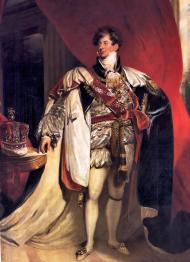
Jorge IV del Reino Unido apodado «El rey Dandi», «El Primer Caballero de Inglaterra» y despectivamente «El Príncipe de las ballenas» (George Augustus Frederick; nacido en el Palacio de St. James, Londres, 12 de agosto de 1762 y fallecido en el castillo Castillo de Winsor, Berkshire, 26 de junio de 1830) fue rey del Reino Unido y de Hannover, desde su ascenso al trono el 29 de enero de 1820 hasta su muerte en 1830.
Anteriormente había servido como príncipe regente cuando su padre, Jorge III, sufrió una permanente recaída de locura a causa de la porfiria que padecía. La regencia de Jorge —que duró nueve años, desde 1811 hasta la muerte de su padre en 1820— estuvo marcada por la victoria en las Guerras Napoleónicas en Europa. Jorge IV fue un monarca que interfirió en numerosas ocasiones en la política (especialmente en el asunto de la emancipación católica), aunque no estuvo tan presente en su reinado como lo fue el de su padre, destacando más en su labor como regente antes de llegar a ser rey. Durante la mayor parte de su regencia y reinado, lord Liverpool controló el gobierno como primer ministro. Jorge IV también es recordado como un príncipe y monarca extravagante.
Se dice que cada vez que Jorge IV conquistaba una mujer, cortaba un mechón de su cabello y lo colocaba en un sobre con el nombre de la dama, como "trofeo". En el momento de su muerte se asegura que tenía en su poder siete mil de estos sobres con cabellos. Tuvo una pésima relación con su padre y con su mujer, Carolina de Brunswick-Wolfenbüttel, a la que llegó a excluir de su coronación. Fue, sin embargo, un patrono de las artes; durante su regencia y su reinado destacaron figuras literarias como lord Byron, Walter Scott y Jane Austen. Jorge IV fue responsable de la construcción del Royal Pavilion en Brighton.
Leer más...